7,500+ Reviews
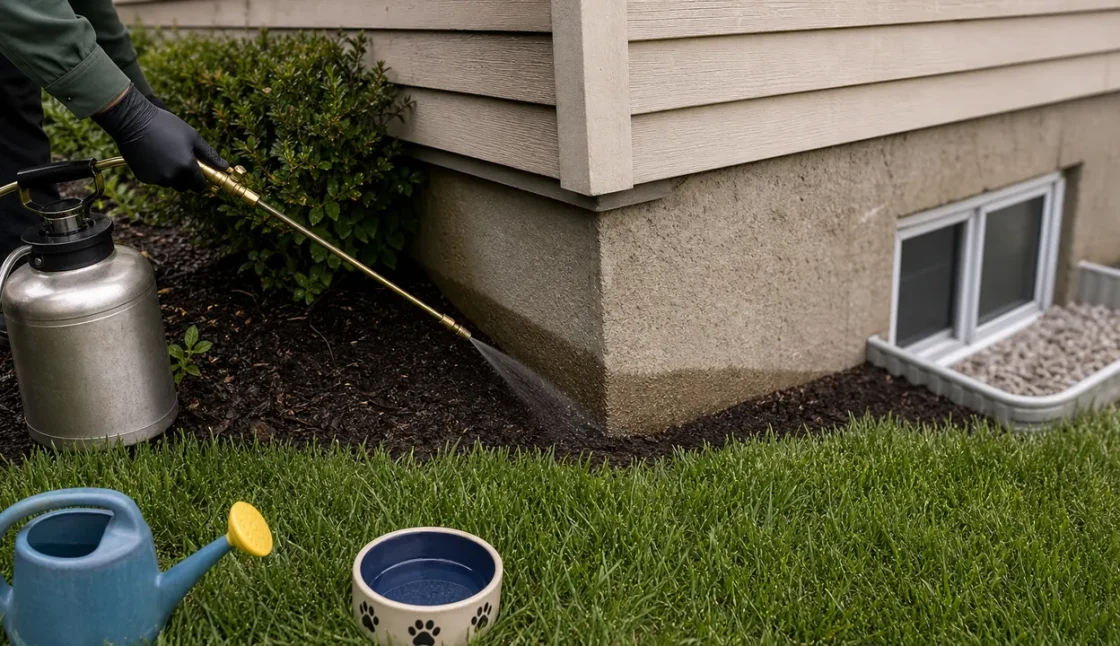
This FAQ covers how spider and ant perimeter pest control treatment works for Oakville homes: what is applied, when children and pets can return to treated areas, how overspray and runoff are limited, and what to expect between visits. It applies to exterior treatments around foundations, eaves, window frames, garage edges and door thresholds.
Exact products vary by property and inspection findings. Wherever this page mentions timing, the label on the product applied to your home takes priority over any general guidance here.
What products are used in spider and ant perimeter treatments?
Perimeter treatments are applied to the foundation and entry-point zone, not across the whole yard. The product choice depends on what the technician finds at inspection (spider harbourage, active ant trails, nest location) and on the directions printed on the product label.
Three method types are typically involved:
| Method | Typical use | Product class |
|---|---|---|
| Liquid residual barrier | Foundation base, window and door frames, eaves, garage edges | Pyrethroid-class insecticides are commonly used for residual exterior barriers |
| Dusting | Voids, wall gaps, soffit edges and other dry, sheltered spots | Labelled insecticidal dusts |
| Baiting | Ant colonies, where bait carried back to the nest is more effective than a surface barrier | Labelled ant baits |
For spiders, Mosquito Man’s spider control service in Oakville combines web removal with treatment of harbourage areas such as eaves, windows and garage edges. For ants, the approach shifts toward locating trails and targeting the colony. The ant control service uses bait for this reason.
Active ingredient disclosure here stays at the class level, because the specific product depends on the job. For the exact product name, active ingredient and directions, ask your technician for the label information on job day.
What happens on job day?
- Inspection. The technician checks the foundation, entry points, eaves and garage for spider activity, webbing and ant trails.
- Targeted treatment. Product is applied to the zones where pests travel or shelter, as the label allows.
- Label information. You can ask to see the product label directions and re-entry requirements for each product applied.
- Timing confirmation. The technician confirms when it’s safe for people and pets to return to the treated zone.
When can children and pets go back?
Re-entry timing comes from the label of the product applied. Health Canada’s guidance on pesticide safety (Canada.ca, October 2025) says people should stay out of treated areas until residues have dried, and some labels specify longer waiting periods. The Canadian Centre for Occupational Health and Safety (CCOHS) also states that re-entry intervals may appear on labels and must be followed.
If you’re unsure, wait longer than the minimum and contact Mosquito Man to confirm.
During application
- Keep children and pets indoors.
- Close windows and doors facing the treatment area.
- Move toys, pet bowls, food and outdoor cushions away from the foundation zone beforehand.
- Keep pets, including cats and dogs that roam outdoors, inside until you’re told otherwise.
After application
- Keep children and pets off treated surfaces until they’re dry and the label’s interval has passed.
- Don’t touch wet residue. If skin contact happens, wash with soap and water.
- Check the foundation edge before letting pets or children play near it again.
- Keep water bowls and play items away from the treated strip.
How is the environment protected?
Perimeter work is limited to where pests enter and shelter. That means the foundation base, entry points and eaves, not lawns, gardens or neighbouring property. Process-level safeguards include:
- Applying only to the zones the label permits.
- Avoiding storm drains, catch basins, hard surfaces that drain to the street, and standing water.
- Skipping application when heavy rain is forecast, since rain can carry product off the treated surface.
- Controlling spray direction to reduce drift onto non-target plants.
Mosquito Man’s approach is eco-conscious in the sense of targeted use and limited application area. This page makes no claim of any third-party eco certification.
What to avoid after treatment
- Don’t pressure-wash or hose down the foundation zone right after application.
- Don’t sweep or scrub treated door frames and window sills until the product has dried.
- Trim plants touching the house and seal gaps, which reduces pest pressure. See the spider prevention tips for Oakville homes for the exterior steps that support treatment.
What does the label require?
A pesticide label is the legal instruction set for that product. It states where and how the product can be applied, protective equipment for the applicator, and any re-entry interval.
A Restricted-Entry Interval (REI) is a mandatory period after application during which people shouldn’t enter the treated area, allowing residues to dissipate. Canada.ca’s guidance on REIs notes that exact timing varies by product label.
Pesticides in Canada are registered by Health Canada’s Pest Management Regulatory Agency (PMRA), and Ontario regulates their sale and use through its own framework (see Ontario’s “Guide to pesticide classes”). To verify a product yourself:
- Ask the technician for the product name or PMRA registration number.
- Look it up in Health Canada’s Pesticide Label Search.
- Compare the directions and re-entry statements with what you were told.
Confirm that any company you hire is licensed. Mosquito Man’s technicians are licensed and insured.
What should you expect for re-entry and follow-up?
There’s no single universal waiting time. Many exterior sprays allow re-entry once surfaces are dry, while some pesticide labels call for longer. Health Canada materials include examples where a minimum of two days is advised, so the product on your property is what counts.
Between visits, exterior Home Protection treatments run on a scheduled interval, and the Oakville spider and ant services use treatments every 90 days. Seasonal timing matters: spiders move toward homes in fall, so the seasonal spider control guide recommends perimeter treatment in spring and sealing gaps before migration.
Contact Mosquito Man between scheduled visits if:
- Ant trails return along the foundation or door thresholds.
- New webbing keeps forming at treated eaves and windows.
- Activity continues beyond the first couple of weeks.
Service is no-contract, and the company’s re-treatment and satisfaction guarantee terms apply. Confirm current guarantee wording when you book. For budgeting, spider control cost in Oakville depends on lot size, severity and visit frequency, and a written quote should come before any booking.