7,500+ Reviews
Keeping mosquitoes out of an Ontario yard for the whole summer comes down to three repeatable habits: remove standing water every week, treat the small water sources you can’t drain with a Health Canada-registered larvicide, and use an approved repellent on your skin when you’re outside. This guide walks you through all three.
What you’ll get: a yard with far fewer breeding sites and fewer bites on the patio. Who it’s for: Ontario homeowners with a typical residential lot. Difficulty: easy to moderate. Time: about 10 minutes for the first yard scan, 30 to 60 minutes for setup, then 10 minutes a week. You’ll need: a bucket or tip-out tool, a stiff brush, fine mesh screening, a Health Canada-registered Bti larvicide (only if you have water you can’t drain), an approved personal repellent, and your reading glasses for the labels.
DIY control works best when you can remove the water. Larvicide is a targeted tool for what’s left, and it isn’t a substitute for source reduction. If your property has widespread or hard-to-reach breeding sites, skip to the section on when to call a professional.
What “approved” means for repellents and larvicides in Canada
Health Canada regulates personal insect repellents and mosquito larvicides as pest control products. According to Canada.ca’s “Safe use of personal insect repellents” (May 25, 2018), an approved product carries a Pest Control Product (PCP) registration number on the label. No number means it isn’t approved for sale in Canada, whatever the front of the package claims.
Before you buy anything, find the PCP number, the active ingredient, the directions for use and the precautions on the label. The label is the legal instruction for that product, and it overrides anything in this article, including application rates, schedules and keep-away times.
Repellents: DEET and icaridin
DEET and icaridin (also sold as picaridin) are the two main active ingredients in Health Canada-registered repellents that most Ontario households use. Health Canada’s “Personal insect repellents” guidance (updated June 2, 2021) sets age and concentration limits for each.
- DEET: Health Canada’s guidance sets lower concentration limits for children. For ages 2 to 12, use a product with a maximum of 10% DEET, applied no more than 3 times a day. Check the Health Canada age table for infants and for teens and adults.
- Icaridin: it has its own concentration and frequency limits. Follow the product label and Health Canada’s icaridin guidance, particularly for children.
- Babies: repellents aren’t a substitute for physical protection on infants. Use mosquito netting over strollers and carriers and dress them in light-coloured long sleeves.
A higher concentration doesn’t protect you better. It protects you longer, up to a point, so pick a concentration that matches how long you’ll be outside and who’s wearing it.
Larvicides: Bti for small water sources
Bti (Bacillus thuringiensis israelensis) is a biological larvicide. It kills mosquito larvae when they eat it and doesn’t affect adult mosquitoes that have already hatched. Municipal programs use the same approach. The City of Toronto’s larviciding program, for example, treats water sources as part of West Nile virus prevention during mosquito season, with timing that varies by year.
Retail Bti products usually come as dunks, bits or granules. Which one suits your water source depends on its size, and the label tells you the volume each unit treats. Buy only a product that is registered for the use you intend.
Limits of DIY larviciding. Treat only small, contained water sources you can reach and treat safely. Don’t try to treat ditches, storm ponds, creeks or large areas, and don’t use a product on a surface or water body the label doesn’t list.
A note on licensing: in Ontario, homeowners can use domestic-class products on their own property according to the label. Commercial mosquito spraying for hire requires a licensed exterminator under the province’s pesticide rules, so confirm any company you hire holds a current licence.
How to treat small breeding sites safely
Mosquitoes need only a small amount of standing water, and a hatch takes about a week in warm weather. A weekly cycle breaks that sequence before adults emerge.
Step 1: Scan your yard for standing water
Walk the whole property for 10 minutes. Do it in the evening or after rain, when puddles and refilled containers are easiest to spot.
Check these places first:
- Buckets, watering cans, toys and wheelbarrows.
- Plant saucers and decorative pots without drainage.
- Kiddie pools, birdbaths and pet dishes.
- Clogged eavestroughs and downspout extensions.
- Tarps and pool covers that hold pooled rainwater.
- Tires, old planters and anything with a rim that collects water.
- Low spots in the lawn and around foundations where water sits for days.
- Rain barrels, ponds and water features.
Checkpoint: you should have a written or phone-note list of every water-holding spot. Mark each one as “can drain” or “can’t drain.”
Step 2: Drain and dry everything you can
Empty each container you can move, then scrub the inside with a brush. Mosquito eggs stick to container walls and survive a simple rinse. Flip, store under cover or drill drainage holes in anything that doesn’t need to hold water.
Refresh birdbaths and pet bowls every few days. Clean eavestroughs so water drains and doesn’t pool. Fill or regrade low spots that stay wet.
There’s no reason to treat water you can remove. Draining is cheaper, faster and carries no pesticide risk.
Warning: don’t pour water you’ve emptied onto a spot that will pool again. Send it across the lawn or toward a storm drain.
Step 3: Treat water you can’t drain with Bti
For a rain barrel, pond, water garden or a permanent low area, use a Bti product that’s registered in Canada. Follow this sequence:
- Read the whole label first. Note the PCP number, the active ingredient, the dose per volume of water, the re-treatment interval and any precautions for pets, fish or children.
- Estimate the water volume. Measure the barrel or pond so you apply the right amount. Under-dosing fails and over-dosing wastes product and breaks the label.
- Choose the product format the label directs. Dunks generally float and release slowly in still water, while bits and granules suit shallow or irregular areas. Use the format your product’s label describes for your type of water.
- Wear any protective gear the label calls for and apply the product to the water only.
- Close and store the product as the label directs, out of reach of children and pets.
- Record the date and the product name so you know when the next treatment is due.
Checkpoint: the product went into the water source it’s intended for, at the label dose, and none landed on soil, decking or neighbouring surfaces unless the label says it can.
Step 4: Block access and keep water moving
Prevention alongside treatment cuts the amount of larvicide you need.
- Cover rain barrels with fine mesh screening (mosquito-grade, not window-screen gaps) and secure it so adults can’t squeeze in to lay eggs.
- Keep eavestroughs and downspouts flowing, especially after leaf fall and wind storms.
- Run a pump or fountain in ponds and water features. Moving water is less attractive to egg-laying females.
- Trim long grass and dense shrubs where adult mosquitoes rest during the day. Our guide to keeping mosquitoes out of your yard covers landscape adjustments in more detail.
- Re-scan after every heavy rainfall.
Step 5: Set a summer routine
Standing water returns after rainfall, so one good cleanup in June won’t last until September. Ontario’s mosquito season starts in spring, and West Nile virus surveillance in Canada typically runs from about May through November, depending on the surveillance component, according to Health Infobase’s mosquito-borne disease seasonal update.
A realistic weekly routine:
- Same day each week, repeat the 10-minute scan and empty anything that refilled.
- After heavy rain, do a quick check within 2 days.
- Re-apply Bti only on the interval printed on your product label. Don’t guess or top up early.
- Keep your log of dates and products somewhere you’ll see it.
Garden plants such as rosemary and basil can add a modest scent barrier near seating, but they won’t stop breeding. If you want ideas, see our list of mosquito-repelling plants, and treat them as a bonus.
How to use repellent correctly when you’re outside
Even a clean yard has mosquitoes drifting in from neighbouring properties, ravines and wetlands. Personal repellent covers that gap.
- Read the label and confirm the PCP number, active ingredient and concentration.
- Apply only to exposed skin and clothing as directed. Don’t apply under clothing.
- Spray on yourself in an open, ventilated area. For your face, spray into your hands and apply from there, avoiding eyes and mouth.
- For children, apply the product to your own hands, then rub it on them. Keep it off their hands, since they put them in their mouths and eyes.
- Never apply to cuts, irritated skin or sunburn.
- Wash the repellent off with soap and water when you go indoors.
- If you use sunscreen, apply it first and put the repellent on top.
Checkpoint: you know your product’s re-application interval and daily maximum before you head out.
Label reading and safety tips for children and pets
A pesticide label is a short, dense document. These are the items to find every time:
- The PCP registration number.
- The active ingredient and its concentration.
- The directions for use, including where it can and can’t be applied.
- The re-application interval.
- Keep-off, keep-away or re-entry times for people and pets.
- First aid and storage instructions.
Write down three things before you start: the active ingredient, the re-application interval and the keep-away time. That’s your checkpoint for safe use.
Some specific cautions:
- Keep children and pets away from any treated water until the label says it’s safe.
- Don’t treat a bigger area than the label directs, and don’t use Bti in drinking water.
- Store products in their original containers, out of reach, in a cool dry place.
- Don’t mix products or improvise home blends with chemicals that were never meant for skin or yard use.
Why permethrin isn’t a DIY repellent
Permethrin is a regulated insecticide. It’s registered for specific uses, such as treating clothing and gear under label directions, and it isn’t a skin repellent. It’s also highly toxic to cats. Don’t spray permethrin on your skin, don’t make your own mixtures with it and don’t apply a product to surfaces or fabrics the label doesn’t list. If a product doesn’t show a PCP number or a clear use for your situation, leave it on the shelf.
When DIY is enough and when to call a professional
Use this decision list to choose your next move:
- Are there only a few water sources, and can you reach all of them? If yes, DIY is enough. Drain, screen, treat with Bti where needed and follow the weekly routine.
- Can you read and follow the label for each product, including keep-away times? If yes, continue with DIY. If you’re unsure, ask a professional.
- Is the mosquito pressure still heavy after two to three weeks of weekly checks? If yes, the source may be off your property or hidden in places you can’t reach. Call a pro.
- Do you have drainage ditches, a pond you can’t access, dense treed areas or a large lot? If yes, call a pro.
- Do you want protection for the full season without managing it yourself? A recurring program makes more sense.
What a professional program adds
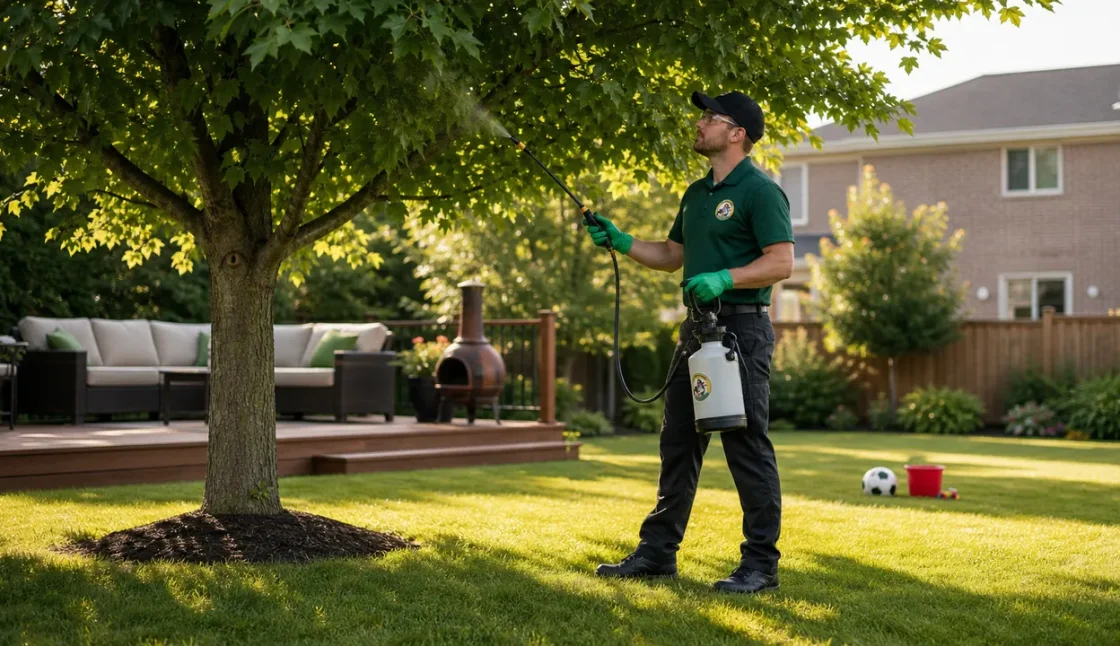
Adult mosquitoes rest in trees, shrubs and shaded vegetation, which DIY larvicide never reaches. Mosquito Man’s Yard Protection program is built around that gap. The company’s service model combines an inspection, standing-water management, larvicide where appropriate and a targeted barrier spray on trees, shrubs and harbourage areas. Yard Protection includes five scheduled treatments about every 21 days, which matches the way new mosquitoes keep arriving all season.
A few customer terms matter if you’re comparing options. Mosquito Man doesn’t require a contract, and you can cancel anytime. The Super Hero Guarantee gives you a free re-treatment within 14 days if pests return, and a full refund if you’re not satisfied. After a treatment, follow your technician’s instructions on re-entry and wait until treated surfaces are completely dry before using the yard.
The company serves homeowners across Ontario, including Toronto, Mississauga, Windsor, Ottawa and Muskoka. For a local example, see mosquito control in Mississauga.
Troubleshooting common problems
Mosquitoes are still biting even though you’ve emptied everything. Check for water you missed, such as clogged gutters, corrugated downspout extensions, tarps, and low spots. Also look next door, since mosquitoes travel from neighbouring yards. If your property is clean and the problem persists, adult populations are probably coming from nearby habitat.
Bti doesn’t seem to be working. Bti only kills larvae. It doesn’t affect adults that have already emerged, and you won’t see a fast drop in biting. Confirm you used the right volume of product, the water source isn’t flowing out quickly, and you’re within the re-treatment interval on the label. Scoop a sample of water into a white cup to check whether larvae are still wriggling.
You can’t tell what size the water source is. Measure it. Length times width times average depth gives you volume. If you can’t get a reliable estimate, that’s a reason to ask a professional rather than guess a dose.
Repellent irritates skin. Wash it off, stop using that product and speak to your pharmacist or doctor if irritation persists. Try a different approved product or a physical barrier such as long sleeves.
Rain keeps refilling containers. Store them upside down, under cover or drill drainage holes. Add a weekly check after every storm.
What you’ve set up and what to do next
You now have a yard routine that deals with mosquito breeding at the source: a weekly scan, drained containers, screened rain barrels, Bti on the water you can’t drain and a clear label record for every product you use. You also have a repellent plan for the hours you’re outside.
Next steps:
- Do your first scan this week and write down every water-holding spot.
- Buy only products showing a PCP number, and read each label before opening it.
- Put a weekly 10-minute check in your calendar through to the first hard frost.
- Look up your municipality or local public health unit for mosquito-control notices and West Nile virus updates, and check Health Canada’s “Personal insect repellents” page for current age and concentration guidance.
- If mosquito pressure stays high, or you’d rather have licensed technicians manage the season, ask Mosquito Man for a quote on Yard Protection.